Joint shareholders – how to create and manage
Can I record joint shareholders in Kudocs?
Yes, you can – very easily! This is done via the stakeholder record. There are several options depending on your circumstances.
You can set up a new stakeholder record for all of the joint shareholders when shares are first issued or transferred to them. Alternatively, set up a stakeholder record just for the ‘main shareholder’ (see below!), and then add the other joint holders’ names afterwards using the ‘Edit stakeholder’ tool.
Read on for more details on both options, including what to take into account when setting up a joint shareholder record.
Note – all of this assumes the joint shareholders are joint legal owners of the shares. For beneficial ownership see our other FAQ here.
Can I issue or transfer shares to joint shareholders in Kudocs?
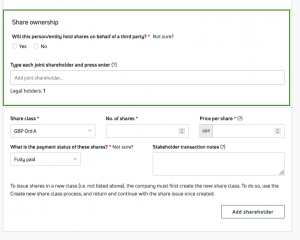
Yes. Just follow the steps to create a new shareholder as part of the share issue or transfer process. When you reach the ‘Share ownership’ section of the new shareholder’s record, click on the ‘Add joint shareholder(s)’ button and type the name of each joint holder. Remember to hit ‘enter’ to save each joint holder’s name!

How do I add or edit details of joint shareholders?
There are 2 ways to do this:
- As above, set up a new shareholder record for the joint shareholding when working through the relevant Kudocs process i.e. share issue or transfer.
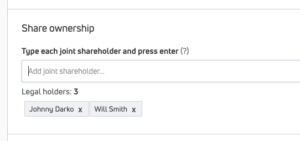
- Add details of the main shareholder as part of the transaction process. Afterwards, add the other joint holders’ names by using the ‘Edit stakeholder’ tool at the top right hand corner of the stakeholder’s page, then ‘Edit details’. Scroll down to the share ownership section and add the joint shareholder names, pressing ‘enter’ after each one.
Who do I enter as the main shareholder and who do I add via the ‘Add joint shareholder(s)’ button?
This is up to you, but will be determined by which of the joint shareholders is the ‘senior’ – i.e. the lead shareholder responsible for voting on behalf of the joint bloc. This is because the Companies Act 2006 (s.286) states that only the ‘senior holder’ in a joint holding can vote. A ‘senior holder’ is helpfully defined here as the holder whose name is listed first in the register of members (as always, subject to the Articles!)
Kudocs reflects this in the stakeholder record system by assuming that the record for the joint shareholding is set up under the name of the ‘senior holder’ (or ‘main shareholder’). That holder will therefore meet the Companies Act definition by being listed first in the register entry. Any other joint shareholders will be listed in the stakeholder record by name only. Kudocs will not ask for any other details of those joint shareholders.
Who should be set up as the ‘senior’ is up to you/ your shareholders. Usually, the main shareholder will also receive official communications from the company on behalf of the other joint shareholders. Check your company’s Articles!
What about where a shareholder owns shares in their own individual right and also as a joint shareholder?
You will need to have separate records for the individual and the joint shareholding.
Some examples:
- Peter, Frank and Jo each hold 50 shares individually and separately in Test Company in their sole names. Frank transfers his 50 shares to Peter and Jo to hold between them as joint shareholders. A new stakeholder record should be set up for Peter and Jo’s joint shareholding, so that this can be kept separate from their individual holdings in Test Company.
- Peter and Jo each hold 50 shares in Test Company. Test Company issues new shares to Jo and director Charlie to hold in joint names, with Charlie as the main shareholder. The joint holding will be logged against a stakeholder record in Charlie’s name. That record will also list Jo as a joint holder, but will not be linked to Jo’s existing stakeholder record. It is up to you whether to use Charlie’s existing stakeholder record from their director role, or create a new record for the joint shareholding.
When there are joint shareholders, who gets emails from Kudocs or votes on shareholder votes run through Kudocs?
If there is more than one joint shareholder, Kudocs will only communicate directly by email with the main/senior shareholder i.e. the main name on the stakeholder record. This is because they are the only ones entitled to vote on shareholder matters under s.286 Companies Act 2006.
However, you can use the notification recipient feature to add email addresses of other joint shareholders. This will tell them that an email has gone out to the main shareholder for action, as well as allow them to receive certain other updates.
Can I incorporate a company with joint shareholders?
We do not support joint shareholdings at incorporation (either in the incorporation questionnaire, or the incorporation tool).
The reason for this is that s.8(1)(b) Companies Act 2006 says that the subscribers agree to become members of the company and ‘to take at least one share each’. If joint subscribers take a share between them, this breaches the requirement that no subscriber can take less than one share.
In practice, it does not matter if there are enough shares to be split evenly between the joint shareholders (e.g. 2, 10, 100). Companies House still rejects all incorporations where there is a set of joint shareholders as a subscriber. To avoid undue delay with Companies House, it is therefore simpler to incorporate with sole subscribers. From a Kudocs perspective, you can then deal with the joint shareholding post-incorporation by:
- adding details of the other joint shareholders to the main shareholder’s record in Kudocs (see above). This just updates the shareholder information – it does not formally change the shareholdings or create a transfer.
- formally transferring the shares from the sole subscriber to the new joint shareholders via Kudocs (which is very simple to do).
There are different opinions about which method is best or most appropriate. If you are not sure what to do, please take professional advice.
In either case, the ‘new’ joint shareholdings will be notified to Companies House in the next confirmation statement. This is easy because Companies House does not object to joint shareholders (even of a single share) in the confirmation statement – only at incorporation.
When the shareholders are joint because they are co-trustees of shares held on trust, there are extra factors to be considered. For more information, see our ‘trusts’ FAQ here.
What do I do about joint shareholders who are PSCs?
Last updated: 23/02/2026 by Kudocs Admin